

Every year on 31 August, International Overdose Awareness Day (IOAD) brings global attention to overdose, remembers people who have lost their lives and supports families and communities affected by drug-related harm. The campaign also emphasizes evidence-based prevention and aims to reduce the stigma surrounding overdose.
Overdose can involve prescription medicines, illicit substances or combinations of drugs. Therefore, improving overdose awareness requires more than recognizing a single drug or symptom. It requires education, appropriate healthcare access and informed responses to potential emergencies.
What Happens During a Drug Overdose?
An overdose occurs when exposure to a substance produces harmful effects that overwhelm normal physiological functions. The clinical presentation varies according to the substance involved. For example, opioid overdose can severely suppress breathing and consciousness, creating a potentially life-threatening emergency.
Not every overdose looks the same. Changes in consciousness, abnormal breathing, unusual behavior, vomiting, seizures or changes in skin color may occur depending on the substance and circumstances. Consequently, suspected overdose requires urgent medical assessment rather than attempts to identify the substance based only on visible symptoms.
Why Awareness Matters?
International Overdose Awareness Day has been observed annually on 31 August since its origins in Melbourne in 2001. Today, the campaign provides a global platform for communities to remember lives lost, share evidence-based prevention information and encourage compassionate responses to people affected by drug use.
Reducing stigma forms an important part of this effort. Fear of judgment can create barriers to communication and healthcare access. In contrast, evidence-based education can encourage people to recognize risks and seek appropriate support. For this reason, overdose awareness should focus on health, prevention and informed action rather than blame.
Understanding Factors That Can Increase Risk
Overdose risk is influenced by several factors and cannot be predicted from substance use alone. The type and amount of substance, individual tolerance, underlying health conditions and concurrent use of multiple substances can all influence the clinical outcome. Changes in tolerance may also alter risk in some circumstances.
Polysubstance exposure deserves particular attention because combining substances can produce unpredictable or additive effects. Therefore, healthcare professionals evaluate suspected drug exposure within the broader clinical picture. Medical history, symptoms, physical findings and appropriate laboratory investigations may all contribute relevant information.
Drug Screening and Clinical Assessment
Drug testing can support healthcare professionals in specific clinical contexts by providing information about exposure to selected substances or drug classes. Urine represents a commonly used specimen for drug screening because metabolites or parent compounds may remain detectable for different periods after exposure.
Importantly, a urine drug screening result does not by itself establish intoxication, impairment, the amount consumed or the clinical severity of an overdose. Screening results may also require additional evaluation or confirmatory methods depending on the clinical situation.
SAMHSA (Substance Abuse and Mental Health Services Administration) similarly emphasizes appropriate implementation and interpretation when clinicians use drug testing in healthcare practice.
DrugFor™ Urine Multi-Drug Screen Test Kit
The Urine Multi-Drug Screen Test Kit is a competitive chromatographic immunoassay intended to screen urine for the presence of selected drugs and drug metabolites. The test uses capillary flow and drug-specific monoclonal antibody conjugates to generate visual screening results according to the defined cut-off levels of the assay.
Available parameters include AMP, BAR, BZO, BUP, COC, THC, MET, MTD, MDMA, MOP, OXY, PCP, PPX, TCA, K2, OPI2000, TML, EDDP, FYL, COT, 6-MAM, APAP, CAF, ETO, ETG, GAB, HMO, LSD, mCAT, MDPV, PGB, ABP-K3, SOMA, XYL, KET, URR-144-K4, MQL, α-PVP, MEP and ALC.
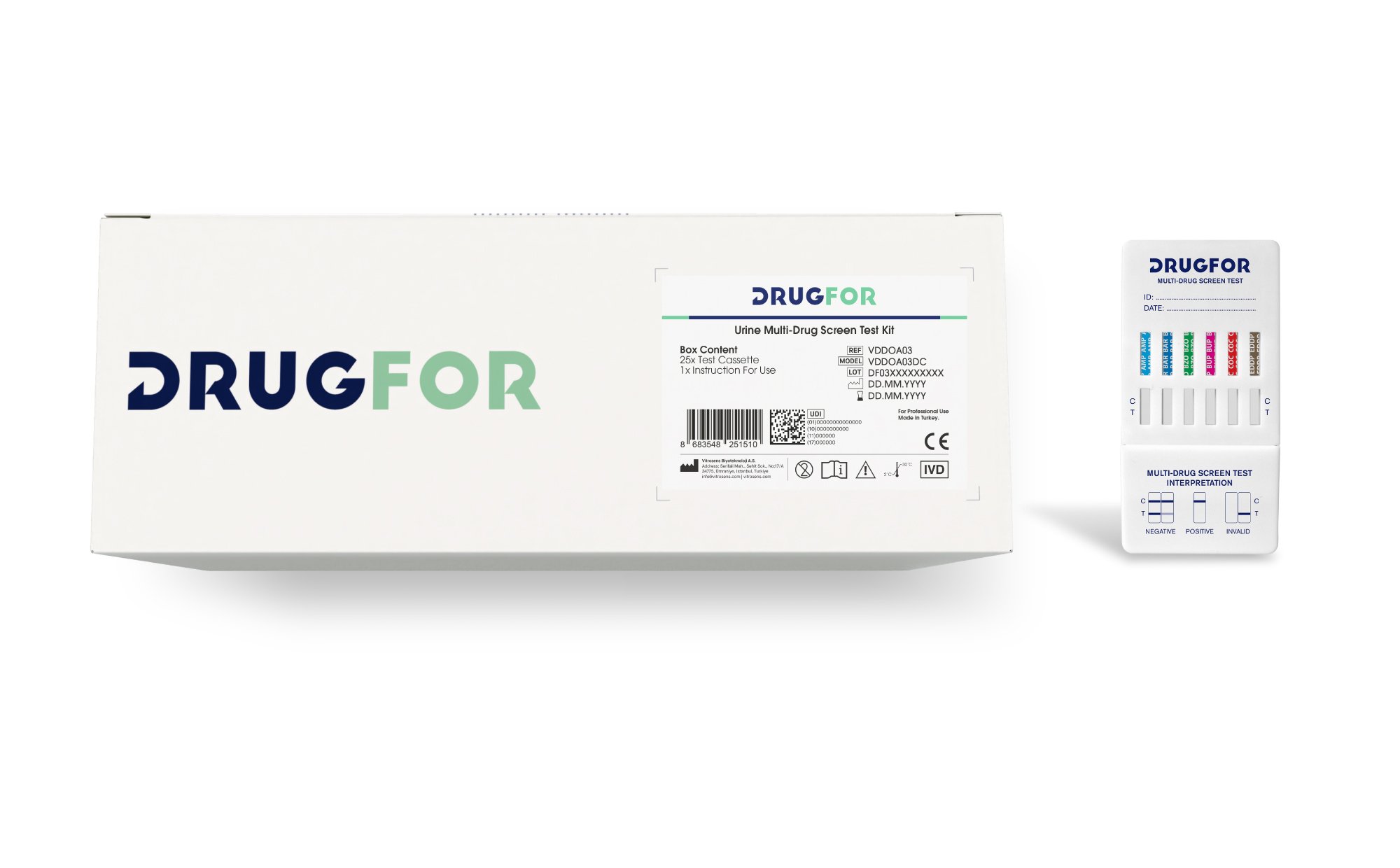
Results are available in approximately 5 minutes. A colored control line confirms that the test has run correctly, while test-line interpretation should follow the applicable Instructions for Use.
! Screening results are preliminary and should not be used alone to determine intoxication, impairment, dose or overdose severity.
Conclusion
International Overdose Awareness Day reinforces another important message: overdose is preventable. Communities, healthcare professionals, families and public health organizations all have roles in reducing drug-related harm. Most importantly, suspected overdose should always be treated as a medical emergency and managed according to applicable emergency guidance.
Laboratory drug screening can provide useful information within appropriate professional workflows. However, clinicians should always interpret results within the broader clinical context and according to the intended use of the assay. For further information, explore the Vitrosens DrugFor catalog or contact sales@vitrosens.com.
References
- International Overdose Awareness Day, Penington Institute. About International Overdose Awareness Day and the Global Campaign.
- SAMHSA. Overdose Awareness Week: International Overdose Awareness Day.
- SAMHSA. Clinical Drug Testing in Primary Care, TAP 32.
- International Overdose Awareness Day. Opioids Factsheet: Signs of Overdose and Overdose Response.
- PACE Hospitals. International Overdose Awareness Day, 31 August.


