

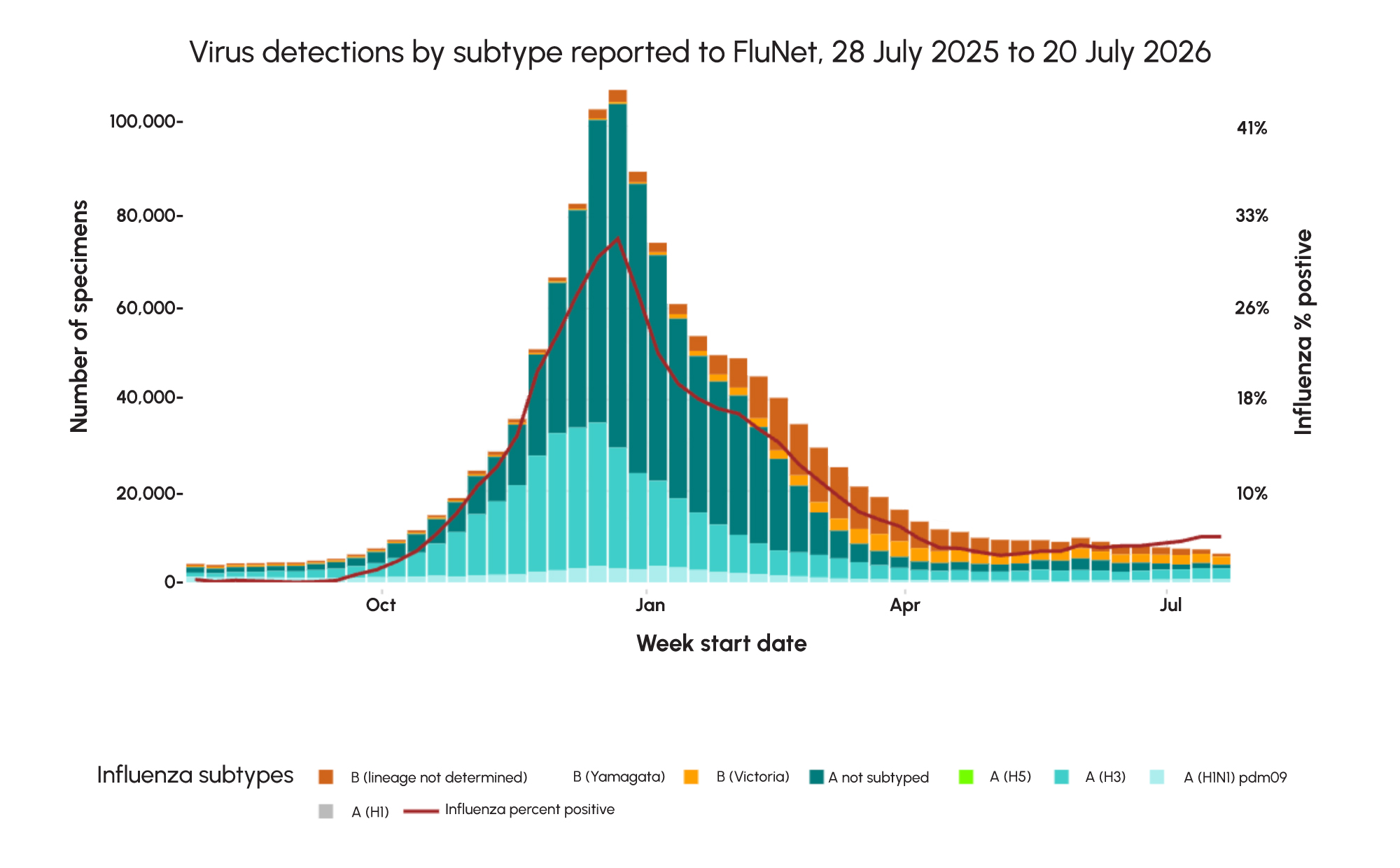
Seasonal influenza continues to be one of the leading causes of acute respiratory infections worldwide. Although many cases resolve without complications, influenza can lead to severe illness in older adults, young children, pregnant women and individuals with underlying medical conditions.
Because influenza viruses continually evolve through genetic changes, molecular laboratory testing plays an important role in identifying circulating strains and supporting public health surveillance.
Understanding Influenza Viruses
Influenza viruses belong to the Orthomyxoviridae family and are classified into several types, with Influenza A and B being the primary causes of seasonal human influenza.
- Influenza A viruses are further categorized into different subtypes based on their hemagglutinin (H) and neuraminidase (N) surface proteins. Among these, H1 lineage viruses continue to be monitored because of their contribution to seasonal influenza circulation.
- Influenza B viruses are not divided into H and N subtypes but remain an important cause of seasonal respiratory infections worldwide.
Why Is Molecular Testing Important?
Symptoms often overlap with those caused by other respiratory pathogens, including fever, cough, sore throat, fatigue and muscle aches. Clinical presentation alone may therefore be insufficient to determine the causative virus.
Real-time PCR is widely used in molecular laboratories because it enables nucleic acid-based detection of respiratory viruses as part of the overall laboratory evaluation. Depending on the assay design, molecular testing may also support the differentiation of influenza virus types or subtypes included within the intended use of the test.
Influenza A (H1Nx): Why Is It Monitored?
Certain Influenza A viruses are further characterized according to their genetic subtype. Monitoring H1 lineage viruses contributes to influenza surveillance programs and helps laboratories characterize circulating influenza viruses according to established public health recommendations.
In terms of symptoms, it is usually not possible to reliably distinguish between A, B or H1N1 based on symptoms alone; fever, cough, sore throat, muscle aches and weakness can all occur. The distinction is mainly done through tests such as PCR/airway panel.
ChainFor™ and LyoSens™ Flu ID-3 Genotyping qPCR Kit
The Flu ID-3 Genotyping qPCR Kit is designed for the qualitative detection and differentiation of Influenza A, Influenza B and Influenza A (H1Nx) by real-time PCR in professional laboratory settings.
The assay is available in two formats to accommodate different laboratory workflow preferences:
- ChainFor™: Conventional real-time PCR format requiring cold-chain storage.
- LyoSens™: Lyophilized (freeze-dried) real-time PCR format designed to simplify storage, transportation and routine laboratory workflow.
Both formats target the same analytes while offering laboratories flexibility in selecting the workflow configuration that best suits their operational requirements. Compatible real-time PCR instruments are specified in the applicable Instructions for Use (IFU).

Conclusion
Influenza viruses remain an important cause of respiratory illness and continue to evolve over time. Molecular laboratory testing supports the detection and differentiation of influenza viruses as part of comprehensive clinical and public health evaluation.
To learn more about the ChainFor™ and LyoSens™ Flu ID-3 Genotyping qPCR Kit, explore the Vitrosens molecular diagnostics portfolio or contact sales@vitrosens.com
References
World Health Organization (WHO). Influenza (Seasonal).
World Health Organization (WHO). FluNet: Global Influenza Virological Surveillance. Global Influenza Surveillance and Response System (GISRS).
Centers for Disease Control and Prevention (CDC). Types of Influenza Viruses.
European Centre for Disease Prevention and Control (ECDC). Seasonal Influenza.


