

Every year on October 13, World Thrombosis Day raises awareness of blood clots, their risk factors and the importance of early recognition.
The 2026 campaign, led by the International Society on Thrombosis and Haemostasis (ISTH), highlights women’s health and how thrombosis risk changes throughout different stages of life, including pregnancy, the postpartum period and menopause.
Alongside awareness and clinical risk assessment, laboratory biomarkers such as D-dimer play an important role in the evaluation of suspected venous thromboembolism (VTE).
What Is Thrombosis?
Thrombosis occurs when a blood clot forms inside a blood vessel, potentially obstructing normal blood flow. Two important manifestations of venous thromboembolism are:
- Deep Vein Thrombosis (DVT): A blood clot that develops in a deep vein, most commonly in the legs.
- Pulmonary Embolism (PE): A potentially life-threatening condition that occurs when a blood clot travels to the pulmonary arteries.
DVT may cause leg swelling, pain or tenderness, while PE can present with sudden shortness of breath, chest pain or other serious symptoms requiring urgent medical attention.
Understanding these conditions is essential because their symptoms may overlap with those of other medical conditions.
Why Does Thrombosis Risk Change Throughout a Woman’s Life?
The World Thrombosis Day 2026 campaign emphasizes the importance of recognizing risk factors associated with women’s reproductive health and hormonal changes.
Several life stages and circumstances can influence venous thrombosis risk:
- Hormonal contraception: Certain estrogen-containing contraceptives are associated with increased VTE risk.
- Pregnancy: Physiological changes in blood coagulation and circulation can increase susceptibility to blood clots.
- Postpartum period: VTE risk remains elevated after childbirth, particularly during the first six weeks.
- Menopause: Age-related factors and certain hormone therapies may influence thrombosis risk.
Other important risk factors include prolonged immobility, surgery, hospitalization, cancer, obesity and a previous history of thrombosis.
However, individual risk varies. Clinical assessment remains essential for determining appropriate preventive and diagnostic approaches.

What Is D-Dimer and Why Is It Important?
D-dimer is a fibrin degradation product released when cross-linked fibrin within a blood clot is broken down through fibrinolysis. Elevated D-dimer levels may indicate increased clot formation and breakdown in the body. D-dimer testing is commonly used as part of the diagnostic evaluation of suspected DVT and PE.
In patients with an appropriately assessed low or unlikely clinical probability of VTE, a negative result from a sufficiently sensitive D-dimer assay may help exclude the condition without further imaging.
However, an elevated D-dimer result does not confirm thrombosis. Increased levels may also occur during pregnancy, inflammation, infection, after surgery and in other clinical conditions.
Therefore, D-dimer results must be interpreted alongside clinical probability assessment and additional investigations when indicated.
How Is D-Dimer Testing Used in Clinical Practice?
Clinical guidelines recommend combining D-dimer testing with structured assessment of the probability of VTE. For example, the NICE guideline on venous thromboembolic diseases describes the use of clinical prediction tools, such as the Wells score, to guide diagnostic decisions.
Depending on the patient’s clinical probability, D-dimer results and other findings, additional investigations such as compression ultrasonography or computed tomography pulmonary angiography (CTPA) may be required.
D-dimer testing is not a standalone diagnostic method or a general screening test for thrombosis. Its usefulness depends on the clinical setting and the performance characteristics of the assay.
Product Focus: RapidFor™ D-Dimer Test Kit
The RapidFor™ D-Dimer Test Kit is part of the Vitrosens Biotechnology cardiac marker rapid test portfolio.
D-dimer testing may contribute to the evaluation of suspected thromboembolic conditions when interpreted alongside clinical findings and established diagnostic pathways.
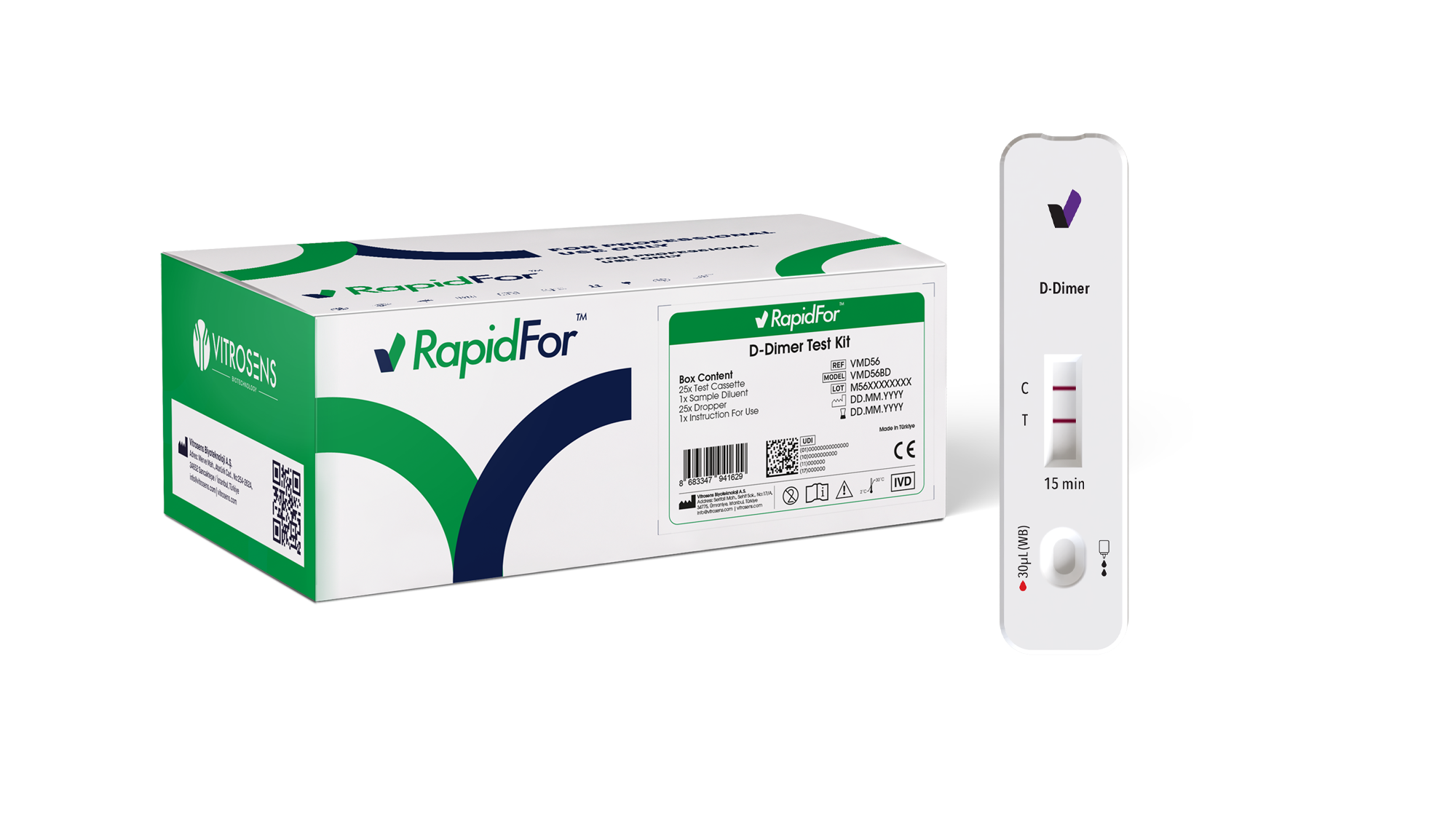
For detailed information about the product’s intended use, specimen requirements, analytical characteristics and result interpretation, healthcare professionals should refer to the current Instructions for Use.
Conclusion
World Thrombosis Day 2026 highlights the importance of understanding how blood clot risks can change throughout a woman’s life.
Recognizing risk factors, identifying warning signs and applying appropriate diagnostic strategies are important components of thrombosis care.
D-dimer testing contributes to the evaluation of suspected venous thromboembolism, particularly when interpreted alongside clinical probability and other diagnostic findings.
To learn more about Vitrosens Biotechnology’s professional diagnostic solutions, explore the Vitrosens portfolio or contact sales@vitrosens.com.
References
- International Society on Thrombosis and Haemostasis (ISTH). World Thrombosis Day 2026 Campaign.
- World Thrombosis Day. Women and Blood Clots: Risk Factors and Prevention.
- National Institute for Health and Care Excellence (NICE). Venous Thromboembolic Diseases: Diagnosis, Management and Thrombophilia Testing. NG158.
- World Thrombosis Day. What Is Thrombosis?


