

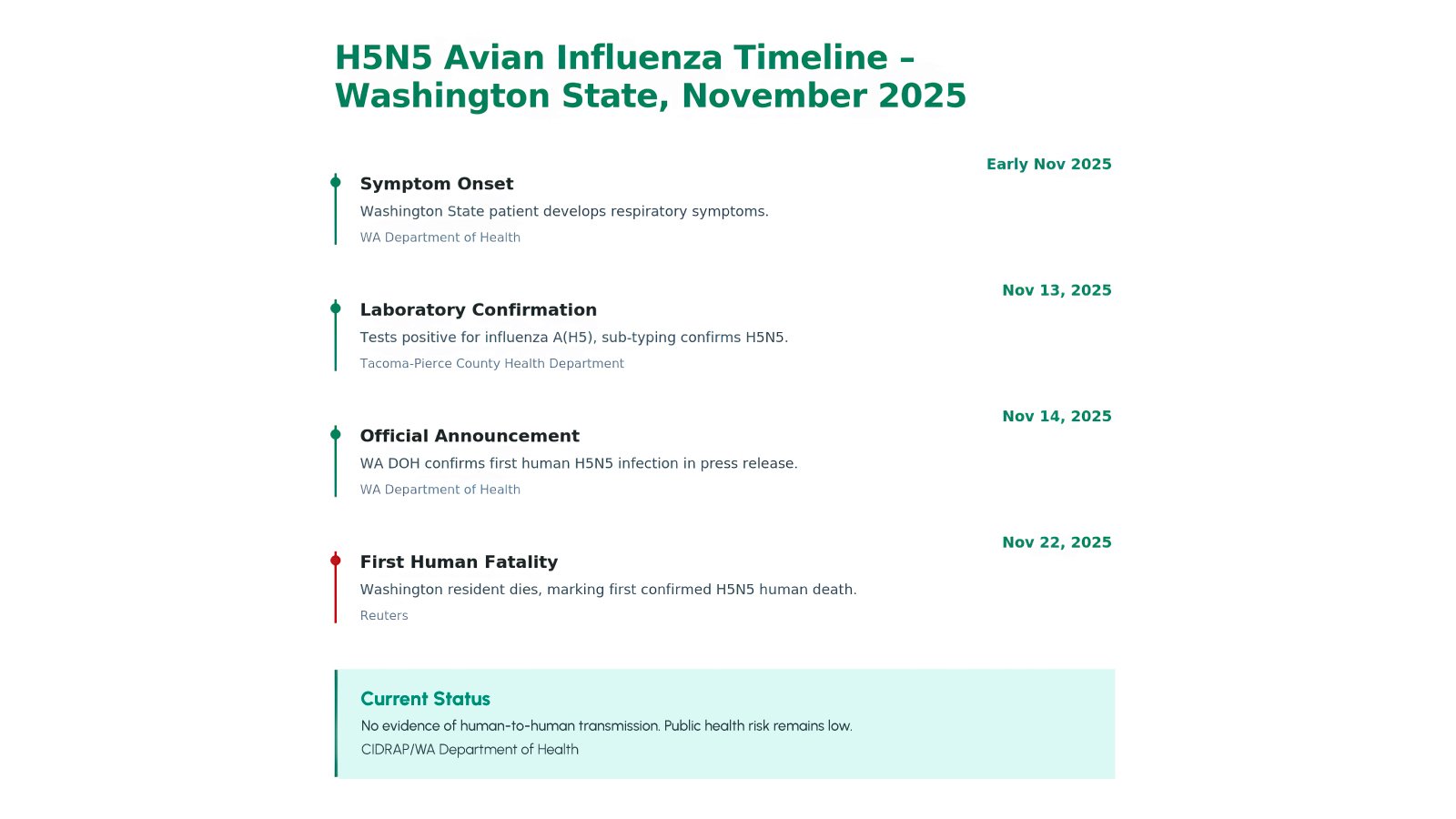
The recent confirmation of the world’s first human infection and death caused by avian influenza A H5N5 in Washington State has directed global attention toward the continuing evolution of avian influenza viruses. Although the overall public health risk remains low according to current CDC assessment, the event illustrates why combined respiratory and avian influenza diagnostics are increasingly important in environments where seasonal respiratory viruses and zoonotic exposures overlap.
A Washington State Department of Health investigation, supported by CDC surveillance, identified an older adult with underlying conditions who was exposed to wild birds and a backyard flock. Environmental sampling around the flock detected avian influenza virus. This case represents a rare spillover event rather than a sign of sustained human transmission. CDC reports no evidence of human-to-human spread, and WHO continues to classify the general risk from H5 viruses in humans as low at this time.
Introduction: What Does the H5N5 Case Mean for This Respiratory Season
Respiratory illness symptoms are often indistinguishable at first presentation. Influenza A subtypes, influenza B, SARS CoV 2, RSV, adenovirus, and even bacterial pneumonia can produce similar early signs. In addition, occasional zoonotic influenza infections may occur in individuals with close animal exposure. The emergence of a confirmed human H5N5 case demonstrates why diagnostic tools that combine routine respiratory detection with targeted avian influenza surveillance can improve early decision making in clinical and occupational settings.
The broader H5 landscape is also evolving. H5Nx viruses within clade 2.3.4.4b continue to circulate among migratory birds across North America, Europe, and Asia. Most human H5 infections worldwide remain linked to direct or environmental contact with infected birds and are recorded as isolated spillover events. Nonetheless, frontline healthcare providers benefit from rapid triage tools that distinguish seasonal respiratory infections from potential high-risk exposures.
Market and Clinical Insight: Why Integrated Diagnostics Are Needed
Clinical Overlap Creates Diagnostic Challenges
Respiratory symptoms such as fever, cough, sore throat, and malaise cannot differentiate between:
- Seasonal Influenza A H1N1 and H3N2
- Influenza B
- SARS CoV 2
- Respiratory Syncytial Virus
- Adenovirus
- Bacterial pneumonia
- Avian influenza exposures in bird-handling populations
In settings with occupational or environmental exposure to birds, distinguishing seasonal influenza from possible avian influenza becomes important for:
- Timely clinical triage
- Exposure management
- Surveillance reporting
- Infection control planning
What Public Health Agencies Are Saying
The most recent CDC FluView report confirms one H5N5 infection in the United States and maintains a low overall public risk. WHO surveillance updates also continue to classify human risk from H5 viruses as low. This reinforces that diagnostic strategies should be balanced, evidence informed, and focused on early identification in relevant exposure scenarios without promoting unnecessary alarm.
How Vitrosens Supports Respiratory and Avian Influenza Detection
Vitrosens provides rapid antigen assays that allow healthcare professionals to evaluate multiple respiratory pathogens quickly while also supporting targeted avian influenza surveillance when needed.
1. Influenza A B Rapid Antigen Test
The RapidFor Influenza A B test detects conserved nucleoprotein antigens of influenza A, which are shared across many influenza A subtypes including several H5 strains. Although this test does not subtype influenza A, a positive Flu A line can serve as an important first indicator in patients with both respiratory symptoms and relevant exposure history.
Key features:
- Differentiation between influenza A and B
- High ease of use with no instrumentation
- Suitable for point of care environments
- Broad influenza A detection through conserved antigen design
2. COVID 19 / Flu A B plus H5 Dual Strip Cassette
Vitrosens also offers a surveillance oriented dual strip cassette that combines:
- A COVID 19 plus Flu A B strip for routine respiratory symptoms
- A dedicated H5 strip for avian influenza detection in high risk contexts
This configuration gives clinicians two levels of information within a single cassette. It supports workflows in:
- Occupational health programs
- Poultry and livestock environments
- Rural health facilities with bird exposure cases
- Emergency response teams investigating unusual influenza presentations
As required by national guidelines, any positive H5 signal must be confirmed by centralized laboratory testing and reported to public health authorities.

Why This Matters: Preparedness, Surveillance and Clinical Clarity
The human H5N5 case does not indicate increased transmissibility or heightened public risk. However, it reinforces a key reality of modern respiratory seasons. Seasonal influenza viruses and occasional zoonotic viruses can circulate at the same time, and exposure histories vary widely. Integrated rapid diagnostics support:
- Early differentiation of common respiratory pathogens
- Faster decision making for exposed individuals
- Strengthened surveillance during unusual events
- Public health responses that are proportional and evidence based
These tools help bridge the gap between routine clinical care and targeted surveillance needs during respiratory season.
Conclusion
The first documented human H5N5 infection highlights the value of early detection tools that address both routine respiratory viruses and rare avian influenza exposures. While CDC and WHO maintain a low risk assessment for H5 viruses in humans, rapid point of care diagnostics remain essential for clinicians, laboratories, and health systems working in high exposure environments. Integrating respiratory testing with targeted avian influenza tools can support timely triage, responsible surveillance, and improved preparedness during the winter season.
For technical documentation, evaluation kits, or guidance on integrating respiratory and avian influenza testing into your health programs, please contact sales@vitrosens.com.
References
- FluView Weekly Influenza Surveillance Report. 2025.
- Washington State Department of Health. Avian Influenza A H5N5 Investigation Update. 2025.
- Avian Influenza Weekly Update. 2024 to 2025.
- Avian Influenza A Viruses in Humans. Background Information.
- Human H5N5 Case Summary and Context. 2025.


